
AI, geopolitical instability, economic uncertainty and an increasingly unpredictable environment aren’t isolated crises — they converge on the same people, at the same time. Here’s what that means for you as a leader, and for how you look after your team while navigating all of it at once.
AI that no longer just executes but decides. Wars and geopolitical instability reshaping markets and supply chains from one month to the next. An economy that offers no clear certainty even a year out. And, increasingly, a climate that disrupts operations and business decisions in ways no one planned for a decade ago. These are crises of a very different nature, and none of them are within your control. But all four converge on the same place: the people in front of you, expecting you to hold some stability even when you don’t fully have it yourself.
It’s not your technical knowledge of AI, your geopolitical read, or your economic forecast — no one has that solved right now, and your team knows it. What’s really being tested is something simpler and more human: whether, when several sources of uncertainty hit at once, you keep thinking with perspective or start deciding from fear. Reactive leadership, under that kind of pressure, tends to control more, listen less, and pass on to the team the same anxiety it’s feeling. A more creative kind of leadership — clear-headed, with its own judgment — doesn’t have more answers than anyone else, but it holds people better while the answers arrive.
Some of what feels unresolvable right now isn't a problem waiting for the right answer — it's a polarity: two poles that are both necessary over time, which can't be permanently resolved in favor of one side without creating new problems. The concept comes from Barry Johnson, PhD, co-founder of Polarity Partnerships — this is an applied introduction to his work, not a claim to the model itself. Control versus delegation, stability versus change, autonomy versus alignment: treat any of these as a problem to solve once, and leadership teams swing like a pendulum — chasing one pole's benefits, hitting its risks, jumping to the opposite pole, and repeating. The goal isn't to stop the pendulum on a fixed point. It's to manage both poles deliberately, so the swing gets smaller and more conscious over time.
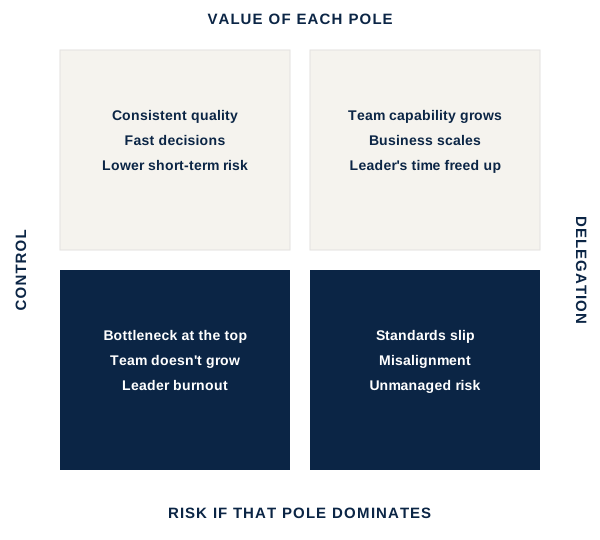
A simplified, educational adaptation of Barry Johnson's polarity mapping concept, applied to Control ⇄ Delegation.
This isn’t about having a definitive answer on AI, geopolitics or the economy — no one does yet. It’s about applying the same process you already use for any high-stakes decision: Clarity on what’s actually changing in your sector, beyond the noise; Impact on which decision you can no longer keep postponing; Mobilization of your team around that decision, not just yourself; and Action on one single thing this week, not the ten things that feel too risky to leave untouched.
Extended video (15-25 min), an original PDF framework/checklist, a practical application workbook, and a curated selection of readings on leading through uncertainty — including Nexus, Yuval Noah Harari, and Principles, Ray Dalio.
Free if you’re an active coaching client · Subscription access for the general public opens soon.